The Egypt Event Market: A Destination-Intelligence Guide for Promoters, Rights-Holders and Attraction Operators
Before launching an event in Egypt, an international organizer should know three things: it is MENA's highest-volume, lowest-ticket-price major market; demand is real and growing on the back of a record tourism cycle; and the operators who fail here are the ones who price and route it like the Gulf. Egypt is a scale play, not a premium play. This guide applies our framework for comparing event destinations to one market in depth.
Part of Choosing Your Next Event Market: A Data-Driven Framework for Comparing Destinations
Verified as of September 2026.
Everything below, demand, seasonality, venues, costs, distribution, partners, licensing, reflects conditions verified as of September 2026. Where a fact can drift, we say so.
Why is this Egypt's strongest market moment?
Because demand-side momentum, supply-side investment and global attention are peaking at the same time. Egypt closed 2025 with a record 19 million tourist arrivals, up 21 percent year on year, roughly four times the global growth average, per the Ministry of Tourism and Antiquities, and the state is now targeting 30 million annual visitors.
The Grand Egyptian Museum, fully opened in November 2025, turned that momentum into a daily spectacle: the government reported around 19,000 visitors a day in its first week of public opening. For attraction operators, GEM is proof that Egyptian and international audiences will queue for a ticketed, timed, premium-produced experience at scale, the same behavior attraction and theme-park operators monetize everywhere else.
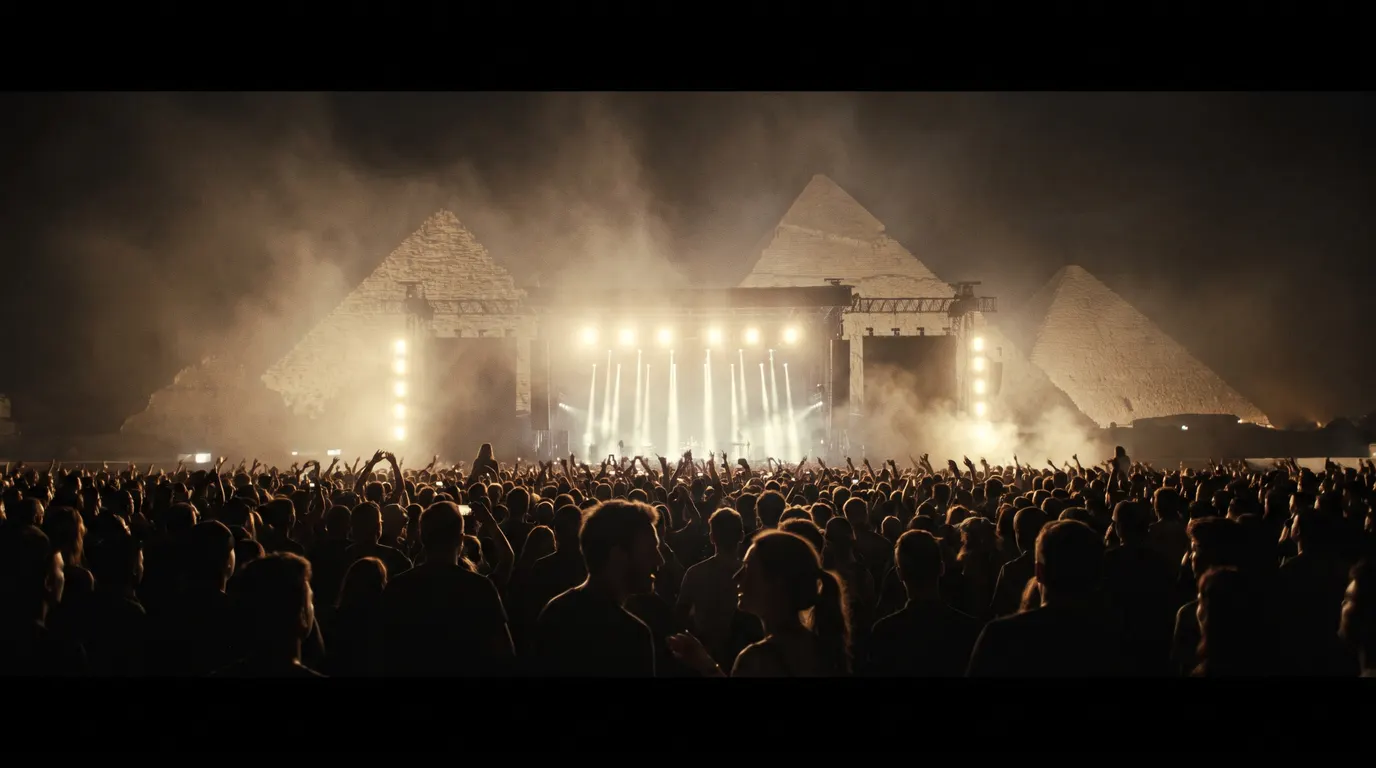
For promoters, the signal is different: a destination with this much inbound attention converts heritage backdrops, the Giza plateau above all, into broadcast-ready venues that sell internationally, not just locally. Few markets anywhere offer that.
What does demand look like in a volume market?
Egypt is the Arab world's most populous country, and its audience economics are the inverse of the Gulf's: an enormous, young, event-hungry base with modest per-capita spending power in a devaluation-prone currency. You will sell more tickets in Egypt than almost anywhere in MENA, at a fraction of Gulf face values.
That splits demand into three layers worth planning for separately. First, the mass domestic audience: price-sensitive, mobile-first, quick to sell out affordable tiers. Second, the affluent domestic segment, concentrated in Cairo's gated compounds and, in summer, on the North Coast, which supports premium tiers priced closer to international levels. Third, inbound: tourists and Gulf visitors who buy heritage-venue events in dollars and euros without blinking.
The practical consequence: tier architecture matters more in Egypt than almost any market we cover in this cluster. A flat Gulf-style price card kills the room. Compare the audience profiles in our UAE market intelligence guide and Saudi Arabia market guide to calibrate the contrast: those are yield markets; Egypt is a throughput market.
When should you schedule an event in Egypt?
October through April is the prime window for Cairo, Giza and the cultural circuit: mild weather, peak inbound tourism, and the strongest calendar of heritage-venue concerts and festivals. If your event trades on international attendance, aim here.
Three calendar forces reshape the year. Ramadan, falling in the February–March window through the late 2020s, pauses conventional daytime programming and shifts demand to post-iftar formats; plan around it or program specifically for it. Summer (June–September) empties affluent Cairo onto the Mediterranean North Coast, where the Sahel season concentrates Egypt's highest-spending domestic audience into a 200-kilometer strip of beach clubs and purpose-built stages, a genuine touring stop in its own right, not a dead season. Autumn brings the Red Sea and cultural-festival circuit, with El Gouna's film-festival week the anchor for premium hospitality demand.
Rights-holders planning multi-year properties should treat the Egyptian calendar the way we describe in our guide to building destination event calendars with tourism partners: anchor to the tourism seasons, not against them.
Which venues can you actually book?
More than at any point in Egypt's modern history, and the pipeline is bigger than the stock. Trade publication IQ reports Egypt is constructing more than 20 new entertainment and sports venues, against a current landscape where true arena-sized rooms are scarce.
Cairo and Giza
Cairo International Stadium (about 75,000 capacity) and its Indoor Halls Complex, the main covered hall holds roughly 16,900, carry the large-format load. The Giza plateau itself operates as a permanent open-air marquee venue: temporary build, total production control, unmatched broadcast value.
The New Administrative Capital
The New Administrative Capital Stadium (93,940 capacity, Africa's second largest, opened 2024) headlines the Egypt International Olympic City, which adds indoor halls of about 15,000 and 8,000 seats. International promoter activity is already organizing around the district, IQ reported an alliance between a leading international promoter and the capital's development authority to route international acts there. Expect this to become Egypt's stadium-show default.
North Coast and Red Sea
Summer inventory lives on the coast: beach-club stages and festival grounds around Sahel and New Alamein, plus resort venues in El Gouna and Somabay for boutique-capacity, high-yield formats. These are seasonal, weather-dependent and largely temporary-infrastructure venues, budget accordingly.
What will it cost, and how should you price it?
Cost structure is Egypt's quiet advantage: local crew, staffing, catering, security and ground transport are priced in Egyptian pounds, so the operating base of an event costs materially less than an equivalent Gulf build. What stays expensive is everything imported, headline talent fees, specialist production kit, international freight, which is priced in hard currency.
Price the house wide, not high. A workable Egyptian price card runs from aggressively affordable general admission, the tiers that create the sell-out and the social proof, up through premium and hospitality tiers that capture the affluent domestic and inbound layers. The revenue center of gravity sits in volume; the margin lives in the top tiers.
Treat currency as a line item: agree settlement currency and timing with every counterparty upfront, keep FX exposure windows short, and model your break-even in both pounds and your home currency. Organizers who skip this arithmetic in devaluation-prone markets discover their margin was an exchange-rate bet.
How do you market and distribute tickets in Egypt?
Egypt is a social-first, mobile-first ticket market: discovery happens on social platforms and through creator and community channels, and conversion happens on phones. Plan a distribution architecture rather than a single storefront, official channel plus tourism, hotel, telco and partner channels, the model our distribution partner ecosystem runs for events worldwide.
For heritage-venue and destination events, international distribution is half the commercial story: packaging tickets with travel and accommodation converts the 19-million-visitor pipeline into attendees. Our playbook on destination events and tourism strategy covers how organizers structure those partnerships.
Who do you need on the ground?
A credible local partner is not optional in Egypt, it is the market-entry mechanism. Established Cairo promoters and event houses hold the venue relationships, the licensing fluency and the production networks that determine whether your timeline is realistic. International entrants who try to run Egypt remotely join a long list of cancelled announcements.
Build the partner stack early: local promoter or production partner, licensing counsel, venue authority contacts, and a ticketing and distribution partner with regional operating depth. webook.com operates across MENA with 40M+ tickets processed for 18M+ users across 180+ countries, on marquee properties from Formula 1 to Riyadh Season, the operational scale Egypt's volume economics demand.
What licenses and approvals do you need?
Verified as of September 2026: every performer on an Egyptian stage, Egyptian or foreign, must be licensed by the Musicians' Syndicate, the state-affiliated body that approves concerts, issues artist work permits and can revoke a permit after it is granted, as The National has documented in cases from Travis Scott's cancelled 2023 Giza show onward. Approval considers content, imagery and what the syndicate deems consistent with Egyptian cultural values.
Beyond the syndicate, expect layered approvals: cultural authorities for content, antiquities and tourism authorities for heritage sites, and security clearances for large gatherings. Three operating rules keep organizers out of trouble: start the licensing track 90 or more days out; route every application through your local partner rather than cold; and treat content sensitivities as a genuine production constraint, not a formality. Licensing here is one planning dimension among many, but it is the one with veto power.
The Egypt market-entry checklist
- Define the play: volume-led domestic event, premium heritage-venue destination event, or seasonal North Coast format, each has a different audience, venue set and price card.
- Pick the window against the calendar: October–April for inbound-facing events, June–September for North Coast, and program deliberately around Ramadan.
- Secure the local partner before the venue: promoter or production house with licensing fluency and venue relationships.
- Open the Musicians' Syndicate and related licensing track at least 90 days out, with content review done before you announce.
- Build a tiered price card in pounds with premium tiers for affluent and inbound layers; never import a Gulf price card.
- Contract currency terms: settlement currency, timing and FX exposure owned by named parties.
- Design distribution as a channel network: official channel, tourism and hotel partners, and international packaging for destination events.
- Model break-even on realistic volume, and pressure-test it against our cross-market framework before committing, the same exercise our Morocco market guide walks through for another North African entry.
Plan the entry with people who run events at this scale
Egypt rewards organizers who arrive with a market-specific plan: volume pricing, seasonal routing, a licensing timeline and a distribution network. That plan is exactly what our commercial team builds with promoters, rights-holders and attraction operators entering new markets. Talk to our commercial team before you commit the calendar slot, the conversation is cheaper than the lesson.
Frequently asked
Is Egypt a profitable market for international promoters?
Yes, when planned as a volume market. Ticket yields are far below Gulf levels, but Egyptian-pound cost bases are lower, audiences are large and underserved, and premium tiers aimed at affluent and inbound buyers restore margin. Profitability failures in Egypt are usually pricing-model failures, not demand failures.
What is the best season for events in Egypt?
October through April for Cairo, Giza and inbound-facing events, when weather and tourism peak. June through September is the North Coast season, which concentrates Egypt's highest-spending domestic audience on the Mediterranean coast. Ramadan, in the February–March window through the late 2020s, requires dedicated formats or a scheduling detour.
Do foreign artists need a license to perform in Egypt?
Yes. Every performer, foreign or Egyptian, must be licensed by the Musicians' Syndicate, which approves concerts, issues work permits and can revoke approval even after granting it. Organizers should open the licensing track at least 90 days before the event and complete content review before announcing. Verified as of September 2026.
How do Egyptian ticket prices compare with the Gulf?
Egyptian face values run at a fraction of UAE or Saudi levels for comparable shows, reflecting local purchasing power in a devaluation-prone currency. Organizers compensate with wide tier ladders: affordable general admission drives volume and sell-outs, while premium and hospitality tiers, plus hard-currency inbound sales, carry the margin.
Let's build your event's ticketing
Tell us about your event and what you want it to achieve, and we'll put a dedicated team on the setup that fits.
Get started now