The Dark-Day Problem: Venue Revenue When There Is No Event
How can a stadium or venue make money on days without events? By treating dark days as an inventory problem rather than a sales problem. Tours, behind-the-scenes experiences, corporate hire, recurring programming and memberships are products a venue can catalogue, price and distribute through the same rails it already uses for tickets. Venues that do this turn a fixed-cost liability into a second P&L. Venues that do not are paying, every day, to keep the lights off.
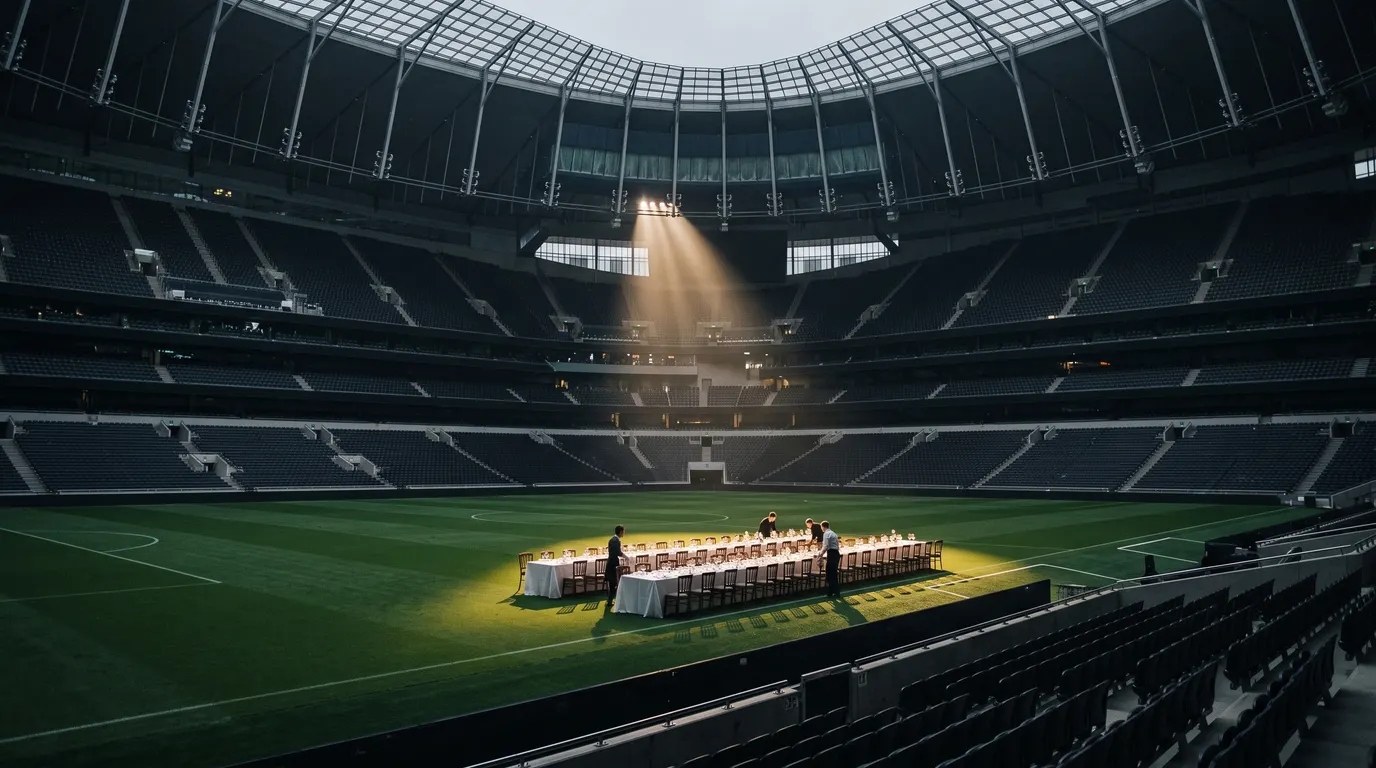
This is no longer a fringe idea. Deloitte's 2026 Sports Industry Outlook flags non-game-day programming becoming core to operating models and sponsorship deals as one of its signposts for the year, and stadium-finance analysis now describes modern venues as mixed-use entertainment platforms rather than single-purpose matchday infrastructure. What follows is a working framework for commercial directors: what a dark day costs, the four families of non-event inventory, how to price and distribute them, and a 90-day plan to get started.
In this guide
- What does a dark day actually cost?
- The four inventory families
- How should venues price and package non-event inventory?
- Owned channels or marketplace?
- Running dark-day products without event-day headcount
- How do you measure a dark-day program?
- The 90-day starter plan
- Where webook.com fits
- Frequently asked questions
What does a dark day actually cost?
A dark day costs your venue its full daily share of fixed overhead and returns nothing against it. Staffing, security, utilities, insurance, maintenance and financing carry on whether or not anyone walks through the gate. The arithmetic is rarely done because nobody owns it: event days have a P&L; dark days have nobody.
Run the model on your own numbers, the figures below are illustrative modelling, not industry benchmarks. Assume a 12,000-seat arena with 140 event days a year and annual fixed operating costs of 8 million dollars. That works out to roughly 22,000 dollars of overhead per calendar day, and 225 dark days, or about 4.9 million dollars a year, with no revenue set against them. A dark-day program that recovers even 20 percent of that figure is a seven-figure line that requires no new building and no new headline act.
The stakes rise with capital intensity. The same stadium-finance analysis notes that new-build budgets now frequently exceed the billion-pound range, which is precisely why lenders increasingly underwrite venues on diversified, year-round revenue rather than on the event calendar alone. A credible dark-day P&L is no longer just an operations win; it is a financing asset.
The four inventory families
Venues that earn on dark days do not improvise one-off ideas; they run a catalogue. Almost everything that works falls into four families, and most venues can field products from at least three of them.
1. Tours and museum-style visits
The anchor product. FC Barcelona's club museum, the entry point to its stadium tour, drew 1.7 million visitors in 2015 and ranks as the most visited museum in Catalonia, by the club's own account. Tottenham Hotspur Stadium reports nearly two million visitors a year across stadium tours, the Dare Skywalk roof climb and its other attractions (club-reported figures, verified September 2026). A venue does not need a trophy room to sell access: the pitch, the tunnel, the control room and the view from the roof are inventory. Price them as timed-entry products exactly as a museum would, our museum and cultural venue playbook covers the mechanics. The GCC's new generation of arenas and entertainment destinations, built for year-round visitation from day one, makes this the natural first product there too.
2. Corporate and private hire
Lounges, boardrooms, pitch-side suites and concourses are meeting and banqueting space with a story attached. Weekday daytime demand, conferences, product launches, off-sites, private celebrations, is the mirror image of an event calendar that peaks on evenings and weekends, which is what makes hire the highest-margin complement to it. Tottenham runs a year-round conference and events business on exactly this logic. Catalogue every sellable space with capacity, dayparts and catering options, and publish rate cards rather than waiting for inbound requests.
3. Recurring experiences and F&B programming
One-off ideas exhaust teams; repeatable formats compound. Football Benchmark's stadium-revenue analysis points to venues adding karting circuits, street-food markets and other permanent experiences precisely because they sell on days the bowl is dark. The same logic applies to chef-led dinners in hospitality kitchens, family days and seasonal formats. The test for this family is simple: can it run every week with the same small crew? Our playbooks on recurring attraction revenue and on dining experiences show how operators structure these.
4. Memberships and community
Committed-access products monetize loyalty across the whole calendar rather than per visit. At the top end the sums are striking: Football Benchmark reports Real Madrid raising 70 million euros from 475 premium seat licences, and FC Barcelona 100 million euros from 300 VIP seats. Most venues will operate several tiers down, annual tour passes, priority-booking memberships, youth clinics, community programs, but the mechanism is identical: predictable revenue banked in advance. Our guide to premium seating and membership revenue covers how to ladder the tiers.
How should venues price and package non-event inventory?
Price against the visitor's alternatives, not against your costs. A stadium tour competes with the city's other paid attractions; corporate hire competes with hotels and conference centres; a membership competes with simply buying twice. Anchor each product to its local comparison set, then use packaging to lift yield:
- Tier every product. A standard tour, a premium behind-the-scenes version and a small-group VIP slot can triple the yield spread on the same fixed cost.
- Sell timed-entry slots, not open access. Slots smooth staffing and create scarcity you can price.
- Use peak and off-peak pricing. School holidays and event-adjacent dates carry premiums; wet Tuesday mornings carry discounts.
- Bundle across families, tour plus retail credit, hire plus hospitality, membership plus guest passes, so every booking carries a second margin.
Resist underpricing the flagship. The premium tier is not only revenue; it anchors the perceived value of everything below it.
Should venues sell non-event inventory on owned channels or a marketplace?
Both, they do different jobs. Owned channels maximize margin and first-party data on demand you already have. A marketplace supplies demand you do not: tourists, families and casual visitors who have never opened your website and never will.
This is where distribution scale matters. webook.com puts venue inventory, tours, experiences, attractions and memberships listed alongside event tickets, in front of 18 million-plus users who have bought more than 40 million tickets across 180-plus countries. For a venue in Riyadh or Jeddah, where arenas and entertainment destinations are explicitly designed for year-round visitation, marketplace distribution is the difference between a tour product locals know about and one visitors actually find.
Running dark-day products without event-day headcount
A dark-day product should run on a fraction of event staffing, or it is not worth running. The operating model is timed slots, self-serve online booking, QR-coded entry and the same scanning and access-control rails you already use on event days, no manned box office required. Our stadium and venue entry operations playbook covers the gate-side detail.
Discipline beats ambition here. Launch with two or three products, cap slot capacity to what one duty team can host, and expand only when utilization data says so.
How do you measure a dark-day program?
Measure it the way a hotel measures rooms: occupancy and yield. Six KPIs cover it:
- Dark-day utilization, the share of non-event days with at least one paid product operating.
- Revenue per available dark day, tracked monthly against your fixed-cost model.
- Fixed-cost recovery ratio, non-event contribution margin divided by the overhead attributed to dark days.
- Yield per visitor, admission plus retail plus F&B, per head.
- Membership conversion, the share of tour and experience guests who upgrade to a recurring product.
- Non-event share of total venue revenue, the board-level number.
webook PRO tracks sales, audience behaviour and revenue across event and non-event inventory in one reporting view, which is what turns the recovery ratio into a weekly habit instead of an annual archaeology project.
The 90-day starter plan
Days 1–30: catalogue and baseline
Walk the building with a spreadsheet. List every sellable space and daypart, build the fixed-cost model above with your real numbers, and pick the two products with the shortest path to sellable, for most venues, a timed-entry tour and corporate hire of existing hospitality spaces.
Days 31–60: price, package, publish
Set rate cards and timed-entry schedules, shoot the photography, and put the booking flow live on your owned channel with the marketplace listing prepared. Define the staffing model as one duty team, and write the run-sheet a supervisor can execute without you.
Days 61–90: distribute, measure, decide
Open marketplace distribution, review the six KPIs weekly, kill what underperforms and scale what sells. Then take the fixed-cost recovery ratio to the board, with the next two products already costed.
Where webook.com fits
webook.com operates the commerce layer this playbook assumes: bookable tours, experiences and attraction inventory listed alongside event tickets, membership products, e-commerce and merchandise, and reporting that treats non-event revenue as a first-class line. webook PRO manages event and non-event inventory in one catalogue, and our commercial consultation team helps venues model which inventory families to launch first, and what each is worth.
Frequently asked questions
Dark days are the largest unpriced asset most venues own. Catalogue yours, price them and put them on sale, list your venue inventory and talk to the team.
Frequently asked
How can a stadium or venue make money on days without events?
By selling non-event inventory: guided tours and museum-style visits, corporate and private hire of lounges and pitch-side spaces, recurring experiences such as karting or dining formats, and memberships. Catalogue the spaces, price them as timed-entry products, and distribute them through owned channels plus a marketplace, exactly as you distribute tickets.
What is a dark day in venue management?
A dark day is any date on which a venue hosts no ticketed event. For most stadiums, arenas and theatres that is the majority of the calendar. Each one still carries the venue's full daily fixed overhead, staffing, security, utilities, insurance, maintenance, with no revenue set against it unless non-event products are on sale.
Do stadium tours really generate meaningful revenue?
Club-reported figures say yes. FC Barcelona's museum, the gateway to its stadium tour, drew 1.7 million visitors in 2015 and ranks as Catalonia's most visited museum; Tottenham Hotspur Stadium reports nearly two million visitors a year across its tours and attractions. Yield per visitor then compounds through retail and food and beverage.
What should a venue launch first on dark days?
Start with the two lowest-capex products: a timed-entry tour and corporate hire of existing hospitality spaces. Both use spaces and staff you already have, can be live within 90 days, and generate the utilization data that justifies, or kills, the next products on the list.
Let's build your event's ticketing
Tell us about your event and what you want it to achieve, and we'll put a dedicated team on the setup that fits.
Get started now